
Start with the Right Measurement Mindset
To improve performance with an AI search ecosystem, you need a measurement strategy that matches how people actually discover brands. Unlike traditional rankings, AI answers often summarize sources and decide what to cite. That means your visibility is AI Visibility Platform influenced by whether your content is referenced, not just whether it ranks. An expert recommendation is to track mentions and citations across multiple AI surfaces rather than relying on a single channel.
When you measure visibility, include both brand mentions and citation behavior, because the two tell different stories. Mentions indicate awareness, while citations indicate authority and retrieval confidence. If you see mentions without citations, your brand may be treated as background context rather than a source. If you see citations but few mentions, your content may be working when the system needs evidence, but it may not be broad enough to trigger repeated reference.
Use a Multi-AI Coverage Plan for Real-World Signals
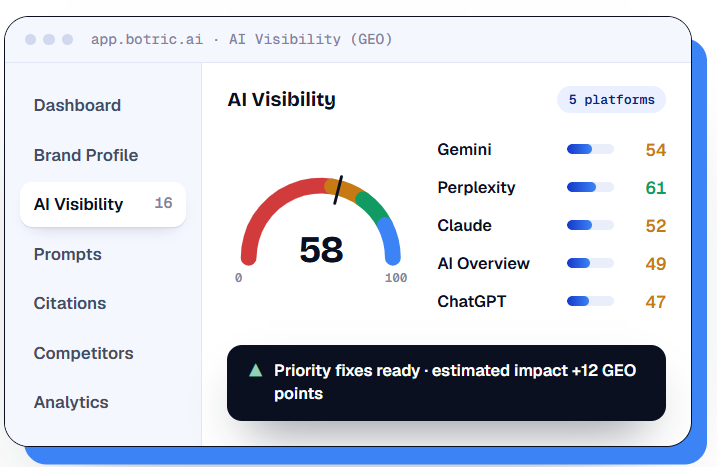
An AI visibility tracker should cover the major systems that influence purchase decisions, research, and competitive comparisons. Look for measurement across ChatGPT, Google AI Overviews, Gemini, Perplexity, and Claude so you can detect where your brand is gaining traction. Different systems apply different retrieval and summarization patterns, so the same content can perform differently. With multi-platform visibility data, you can prioritize optimization based on where incremental gains are most likely.
Experts also recommend segmenting results by intent types, since AI responses vary by query purpose. For example, informational prompts may cite different sources than comparison prompts, and commercial prompts may surface different pages. If your visibility is concentrated in one intent category, your growth plan may need to adjust content structure and topic coverage. Building a coverage plan that reflects user intent helps you align future work with the way AI systems interpret relevance.
In practice, you should plan measurement around repeatable query sets that reflect how prospects think. Create a list of brand-related prompts, category prompts, and “problem + solution” prompts that your customers use. Then compare how often your brand appears and how often it is cited across each AI surface. This approach turns vague benchmarking into an actionable diagnostic, because you can connect visibility changes to specific content or PR activities.
Optimize Content for Retrieval, Not Just Readability
AI systems tend to prefer content that is easy to retrieve and easy to attribute. That means you should structure pages with clear topics, consistent terminology, and evidence-forward sections. Avoid burying key claims behind vague copy, and make sure important details are present in plain language. When your pages are designed for extraction, you increase the likelihood that AI will reference them accurately.
Beyond readability, focus on citation readiness. Add supporting data, describe methodology when relevant, and include direct explanations that an AI model can summarize without guessing. If you publish studies, benchmarks, or product claims, include context so the information remains meaningful in an abbreviated answer. An expert recommendation is to ensure that your most authoritative pages are crawlable, well-indexed, and internally linked from supporting resources.
Also pay attention to how brand signals appear across your site. Consistent naming, unified product descriptions, and clear ownership details reduce ambiguity for retrieval systems. If your brand identity is fragmented across multiple pages or domains, AI may struggle to map mentions to a single authoritative entity. Strengthening entity clarity can improve both mention frequency and citation reliability.
Turn Visibility Data into a Repeatable Expert Workflow
Measurement should lead to decisions, not dashboards that sit unused. A practical workflow starts by reviewing visibility changes, then isolating which AI surfaces improved or declined. If one system shows stronger citations, inspect the content patterns that likely triggered retrieval, such as topics, phrasing, and source depth. If performance drops, evaluate whether key pages changed, whether new competitors created stronger evidence, or whether your content coverage no longer matches the prompts being asked.
Use the visibility timeline to guide prioritization across marketing, content, and PR. For example, if mentions rise after thought leadership releases but citations lag, you may need to add more sourceable material like data tables, case study summaries, or structured references. If citations improve but mentions remain low, expand top-of-funnel coverage so AI has more opportunities to connect your brand to the query context. This is where an AI visibility tracker becomes a central tool, because it connects actions to outcomes across multiple systems.
Finally, build a feedback loop with your internal teams. Content strategists can adjust outlines based on what is being cited, while PR teams can target distribution to the sources that are most likely to be retrieved. Sales and partnerships can provide insight into the exact questions customers ask, feeding the prompt sets used for measurement. When the workflow is consistent, you get compounding gains: stronger content leads to more citations, and more citations lead to better AI visibility signals over time.
Conclusion
Boosting your AI brand presence requires more than generic SEO, because AI answers are shaped by retrieval, summarization, and attribution. An AI visibility measurement approach should track both mentions and citations across multiple AI surfaces so you understand where authority is taking hold. With that clarity, you can move from guesswork to expert-guided improvements. When you combine multi-AI tracking with retrieval-focused content optimization and a repeatable decision workflow, you create a measurable pathway to growth. Focus on making your best assets citation-ready, align topics with real query intent, and use visibility data to steer future actions. With the right visibility tracking discipline, your brand can earn the references that influence how prospects discover and trust you.