
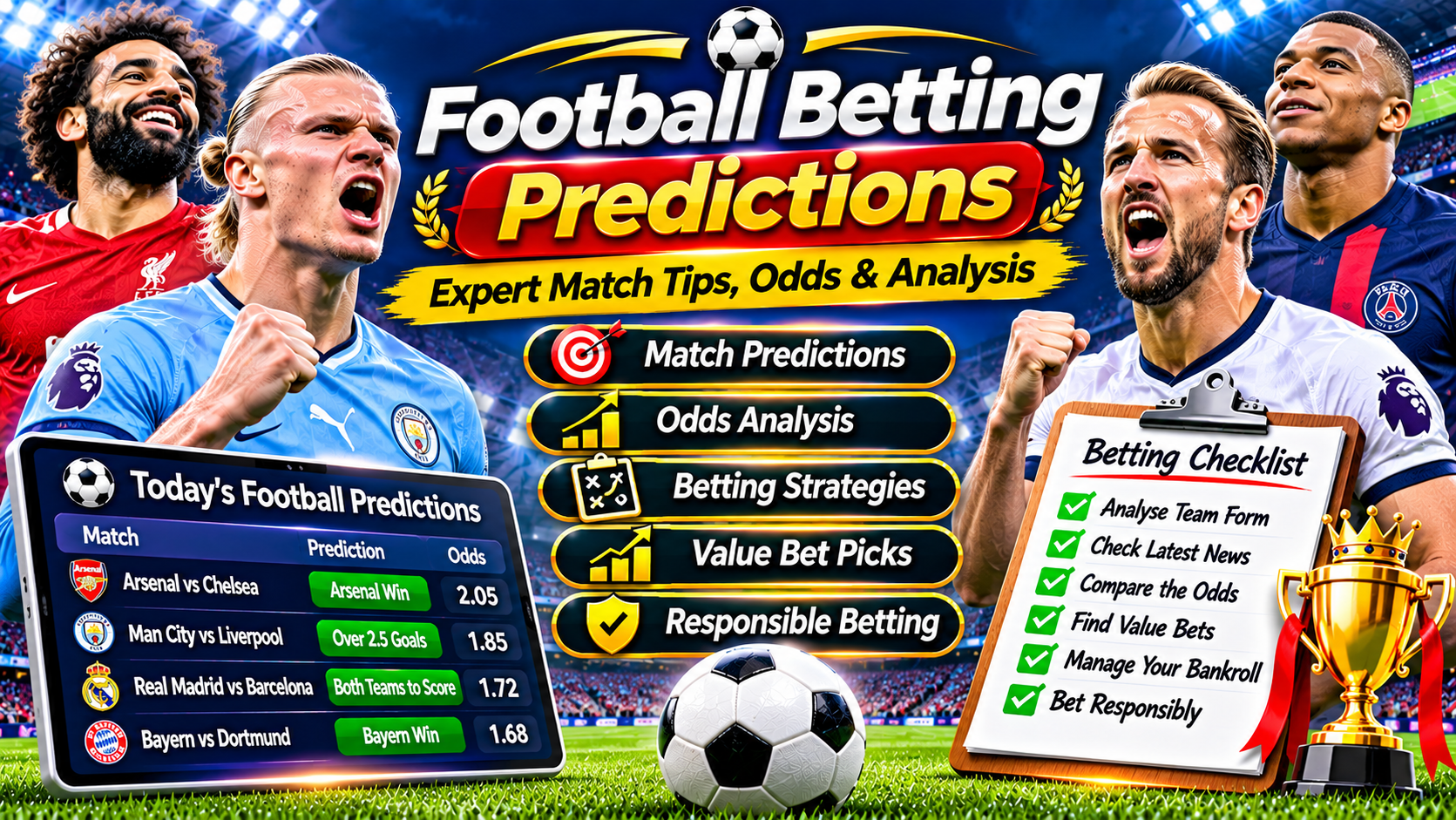
How prediction services differ in value
Some focus heavily on match previews and lineup assumptions, while others lean on statistical models and historical performance. The practical difference is how quickly you Football Betting Predictions can verify their logic and how consistently their picks align with the market. A good service should show you more than a single outcome label—it should guide you toward the reasoning behind goals, tempo, and matchup dynamics.
To compare services effectively, look at their transparency and update habits rather than their claim of accuracy. Services that explain how they weight injuries, tactical matchups, and home/away splits generally help you spot when a pick is exposed to uncertainty. Others may publish “locks” without clarifying what would invalidate the selection. In betting, understanding invalidation conditions matters because line movement often reflects new information. If a service hides the “why,” you’re forced to treat its outputs as black boxes.
Match analysis quality: lineups, tactics, and risk
A strong preview should address the lineup pathways that create scoring chances. That includes likely starters, bench impact, and how formations can translate into goal opportunities rather than just possession percentages. For example, a service that mentions fullback profiles and winger cut-in tendencies can better estimate shot locations and the probability of high-quality chances. When you compare services, prioritize those that discuss tactical matchup variables such as pressing intensity and build-up patterns. These details tend to influence both totals and fair handicap lines.
Risk controls also separate reputable providers from generic prediction aggregators. Some services provide multiple markets—such as double chance, both teams to score, and correct-score ranges—while others only recommend one bet type. Market variety is useful because football rarely plays perfectly to one script. If a pick is vulnerable due to rotation risk, you may still find value in a related market with a different payoff profile. The best services also note when odds are overpriced or when the market already priced in the main narrative.
To illustrate, imagine a match where one side has strong hold-up play but struggles against compact defenses. A simplistic pick might target a single “over” or “under” without acknowledging that the underdog may restrict transition opportunities. A better service would connect tactical compactness to shot quality and pace, then map that to likely goal distributions. That kind of analysis helps you choose safer variants like first-half totals or team totals. When comparing services, examine whether their recommendations stay consistent with their stated tactical reasoning.
Odds, goal markets, and probability alignment
Prediction services should help you interpret odds as implied probability, not just as a number to accept. Even if two services suggest the same match outcome, they may disagree on whether the price compensates for uncertainty. A reliable provider often discusses why one market is more efficient than another based on goal frequency and variance. For goal markets, the key is understanding whether the teams generate chances consistently or only in specific game states. When you compare services, track how they handle low-scoring matchups versus games with clear chance creation.
Look for guidance on totals and both-teams-to-score markets, because these usually reflect matchup mechanics more than pure team strength. If a service claims an “over” but does not address defensive shape and goalkeeper quality, it may be relying on averages that don’t fit the matchup. Conversely, a provider that cites how one team’s pressing can force turnovers may justify an over even if season totals look modest. The best comparisons involve checking whether their probabilities “match” the odds you can actually buy. If the service implies a range of plausible scores, it should also explain why the selected market captures the highest expected value.
Service comparison should also include settlement realism. Some correct-score predictions can be exciting but come with high variance, while alternatives like over 1.5 goals or both teams to score often offer steadier hit rates. A quality service should clarify the tradeoff between payout and probability so you can align picks with your bankroll approach. If you prefer lower variance, you’d lean toward markets with broader coverage and less dependence on exact goal timing. If you prefer aggressive upside, you’d focus on narrower markets, but you should do so with clear awareness of the risk.
Bankroll strategy and responsibility across providers
Even the best prediction output won’t protect you if your staking plan ignores variance. Different services can encourage different behaviors, and it’s important to evaluate whether their guidance supports disciplined betting. A responsible provider should discuss bankroll allocation, risk per bet, and the importance of avoiding chasing losses. When comparing services, consider whether they offer structured recommendations like staking ranges or “confidence tiers.” These elements help you avoid overexposure during rough stretches, which is where many bettors make irreversible mistakes.
Another comparison point is how the service handles uncertainty. If injuries, suspensions, or tactical shifts are likely, a responsible platform should label picks as higher risk rather than presenting false certainty. You should also check whether their content encourages independent verification, such as confirming lineups and market movement before placing bets. That habit matters because team news can change the shape of the game quickly. A strong service doesn’t just predict; it teaches you how to decide when a pick is still valid.
For goal markets specifically, bankroll discipline can be the difference between sustainable progress and burnout. Totals and both-teams-to-score bets can be sensitive to early goal timing, so your staking should reflect that volatility. If a service recommends multiple correlated bets from the same match, you must recognize that correlation reduces diversification benefits. Comparing providers should therefore include how they suggest combining bets and whether they advise against stacking too much exposure on one game. Responsible betting also means setting limits and seeking help if betting becomes problematic.
Conclusion
Focus on transparency, tactical reasoning, market variety, and how well implied probabilities relate to the odds you can place. When you understand the “why” behind a recommendation, you can better judge whether the selection still makes sense after new information. That clarity improves both your results and your confidence in the process. Use responsible bankroll practices to ensure that even the best recommendations don’t dominate your financial plan. Compare whether each provider offers risk guidance, confidence tiers, and uncertainty labeling rather than just bold claims. When you combine disciplined staking with strong match analysis, you move from passive betting to structured decision-making. That is the most reliable way to benefit from expert match previews, goal markets, and odds interpretation across any prediction platform.
1 Comment
I appreciate the focus on trust and quality—when players rely on online casino guides, they deserve editorial standards that prioritize transparent testing, clear explanations of rules, and real attention to payment safety and customer support. It’s helpful when a review doesn’t just list promotions, but also explains how sites handle