
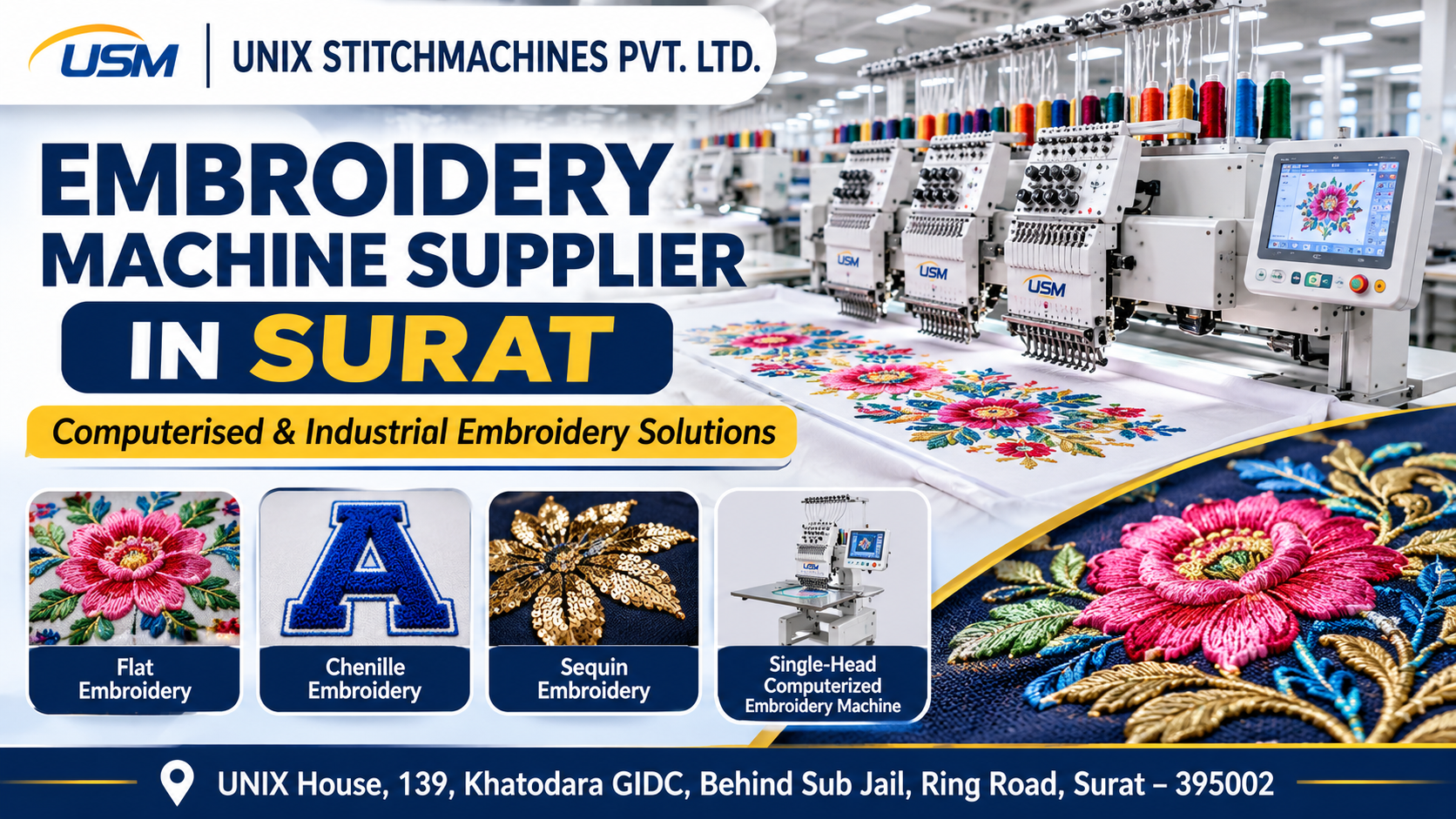
What Makes Industrial Embroidery Worth It
In modern garment production, embroidery is no longer a “nice to have” finishing step. It is a dependable way to add brand identity, decorative texture, and product value to everything from uniforms to promotional caps. When embroidery is handled Computerized Embroidery Machine in Surat with the right machinery, designs stay sharp, placement stays consistent, and production schedules become easier to manage. That reliability is especially important for businesses taking repeat orders or scaling up for seasonal demand.
Surat has a wide ecosystem of textile processing, apparel manufacturing, and embroidery workshops, so competition is strong and customer expectations are high. Buyers often want clean lettering, stable curves, and accurate logo reproduction across many pieces. An embroidery machine that can repeat the same design with minimal variation helps reduce rework and rejects. Over time, this turns embroidery from a manual labor cost into a controllable production system.
Machine Types and How to Match Them to Your Work
Embroidery machines come in several configurations, and the best choice depends on your order volume and design complexity. Single-head machines are a practical starting point for smaller workshops that produce customized pieces, samples, or boutique collections. They can handle variety well, because operators can switch patterns without needing complex planning for multi-item output. For businesses focused on personalized garments, single-head production is often more cost-effective than investing in high-capacity setups.
For larger runs, multi-head machines can embroider multiple garments at the same time, which improves throughput and reduces labor hours per piece. This type is commonly used for uniform suppliers and corporate branding programs where the same logo is applied repeatedly. Industrial embroidery machines are designed for continuous commercial usage, offering robust performance for high-volume factories. If your business relies on digital files and repeatable pattern work, a computerized system becomes the bridge between creative design and consistent production results.
Expert Recommendation: Choosing the Right Computer Control Setup
When you are recommending a machine to a client, the first step is to map requirements to capabilities, not the other way around. Start with what you actually embroider: logos, names, dense fills, thin outlines, or mixed embroidery styles. Then estimate your daily output needs and the fastest turnaround your clients expect. This helps determine whether a single-head, multi-head, or industrial-grade solution fits your workflow without creating bottlenecks.
Next, evaluate the quality drivers that affect real stitching results. Look for stable thread delivery, consistent tension control, and dependable needle performance that reduces skipped stitches and thread breakage. Fabric compatibility matters just as much as design capability, because cotton, polyester, denim, knits, and blended textiles each respond differently to needle type, tension, and stabilizing materials. A strong computerized embroidery setup should support accurate placement and reliable repetition, so the same logo looks uniform on every batch.
Operators also need practical features that reduce downtime. Consider whether the machine supports efficient loading of embroidery patterns, easy adjustments for size and density, and clear settings for thread color changes. Ask about maintenance accessibility, spare parts sourcing, and technician support, because service speed directly impacts production continuity. A recommended machine is one that your team can run confidently, maintain easily, and troubleshoot quickly when production schedules are tight.
Operational Checklist for Cleaner Output and Faster Turnaround
Even with a reliable machine, embroidery quality depends on process discipline. Use the right embroidery thread for the fabric and the desired finish, whether you need a smooth sheen, strong durability, or softer handling for apparel. Select a needle that matches fabric thickness and weave structure to prevent fabric damage and thread tension issues. Proper stabilizing material also prevents shifting, especially on curved areas like pockets, collars, and sleeves.
To control consistency across large orders, review designs before starting bulk production and test on the exact fabric and thread combination. For logo work, confirm alignment marks, hooping position, and stitch direction so letters stay straight and curves remain smooth. Establish standard operating steps for machine calibration, including checking tension settings and ensuring the thread path is clean. Regular cleaning removes dust and thread particles that can cause irregular stitching, which helps reduce quality drift over long runs.
Training is another expert factor that impacts results. Operators should understand how to manage digital files, confirm stitch order, and adjust density when switching fabrics or thread types. Create internal guidelines for common issues such as thread breaks, puckering, or uneven satin fills, and document the corrective actions. When your team can solve problems quickly, the machine becomes a productivity tool instead of a source of delays.
Conclusion
Choosing the correct embroidery machinery can significantly improve product appearance, production stability, and order efficiency. Embroidery is a key finishing process for uniforms, branded apparel, decorative fabrics, and promotional items, and the right machine helps deliver consistent results across repeated batches. By matching machine type, output capacity, fabric compatibility, and maintenance support to your specific workflow, you reduce rework and strengthen customer trust. For businesses exploring a dependable supplier in Surat, Unix Stitch Machines Pvt Ltd is a solid option to evaluate for suitable embroidery solutions. Before finalizing a purchase, compare machine configurations, stitching performance, computerized control features, and service readiness. With expert guidance and the right setup, you can produce cleaner embroidery, faster turnaround, and professional finishing that supports long-term growth.